

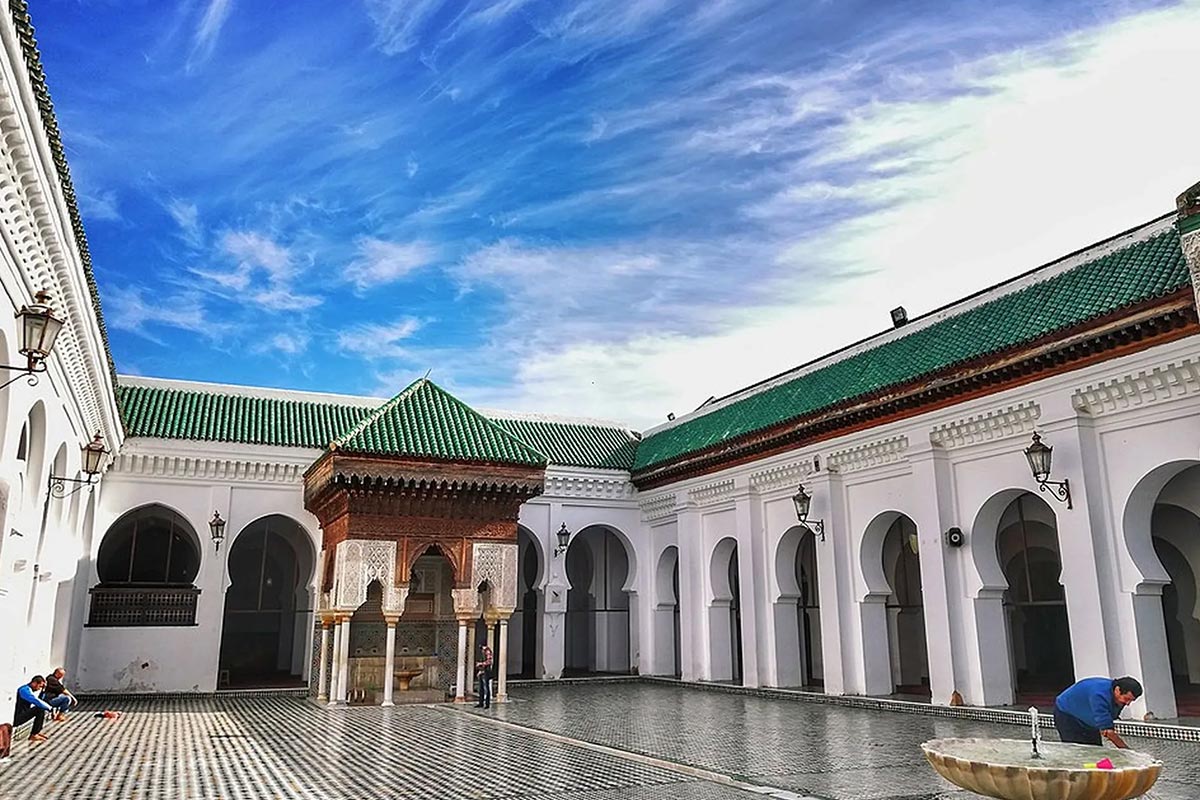
Few places in the world carry the weight of over eleven centuries of history quite like Al Quaraouiyine in Fes, Morocco. Sitting at the heart of the ancient Fes el-Bali Medina, this complex is at once a functioning mosque, a working university, and home to what is widely regarded as the oldest library on Earth. For anyone visiting Al Quaraouiyine Mosque, the experience is as much about atmosphere and awe as it is about architecture; even if you can only admire it from the outside.
That’s a key detail worth knowing upfront: non-Muslim visitors cannot enter the mosque itself. But that limitation takes nothing away from the encounter. The streets around the complex reward the patient and the curious with glimpses of ornate wooden doors, cascading green-tiled rooflines, and the sound of Quranic recitation drifting out into narrow stone lanes. For those interested in things to see in Fes Medina, Al Quaraouiyine is an unmissable stop.
Planning to explore the historic sites of Fes? Join a guided Medina tour to discover hidden landmarks and the stories behind them.
A Brief History of Al Quaraouiyine
The story of Al Quaraouiyine begins in 859 CE, when a woman named Fatima al-Fihri used her entire inheritance to fund the construction of a mosque for her community. Born in the Tunisian city of Qairouan, Fatima al-Fihri migrated with her family to Fes as a young adult during the 9th century, a period when the city was rapidly becoming a major center of commerce and culture.
The university is not only the oldest higher education institution on Earth but also the first to be founded by a woman; and a Muslim one at that. Fatima used her inheritance from her merchant father to found the university, which started as a madrasa and a mosque that eventually grew into a place of higher education. It also introduced the system of awarding degrees according to different levels of study in a range of fields.
Over time, the curriculum expanded far beyond religious instruction. The university evolved into a prominent center for Islamic studies that attracted scholars from across the Arab world, expanding its subjects to cover logic, grammar, music, medicine, astronomy, and mathematics alongside its foundational Islamic sciences.
UNESCO and the Guinness World Records have cited Al Quaraouiyine as the oldest university or oldest continually operating higher learning institution in the world. It was formally incorporated into Morocco’s modern state university system in 1963 and officially renamed the University of Al Quaraouiyine in 1965.
The mosque itself grew dramatically over the centuries. Under the Almoravid ruler Sultan Ali Ibn Yusuf in the 12th century, it was extended from 18 to 21 aisles, expanding to over 3,000 square meters; giving the prayer hall the grand, horseshoe-arched appearance it largely retains today.
Where Is Al Quaraouiyine Located?
Al Quaraouiyine sits in the middle of Fes el-Bali, the oldest walled part of the city and a UNESCO World Heritage Site. Getting there is part of the experience. The Medina has no cars, no straight roads, and (depending on how you navigate) more than its fair share of dead ends. Narrow alleys open unexpectedly into small squares, then narrow again into passages barely wide enough for two people to pass.
The mosque is near the Suq al-Attarin, the famous spice market, which is one of the best-known reference points in the Medina. Fatima al-Fihri originally purchased a prime plot of land near the Suq al-‘Attarin, in the centre of the city of Fez, to build the mosque. That location remains central today; and the surrounding souks, madrasas, and traditional market stalls make this quarter one of the richest stretches of urban heritage anywhere in Africa.
For first-time visitors, the layout of the Medina can feel genuinely disorienting. Streets that appear on maps often don’t match what’s on the ground, and signage is minimal. A knowledgeable local guide makes an enormous difference; not just for navigation, but for understanding what you’re looking at once you arrive.
Exploring the Medina for the first time can be confusing. A local guide can help you reach major landmarks easily.
What Visitors Can See at Al Quaraouiyine
Even without stepping inside, there is a great deal to take in. The perimeter of the complex offers some of the finest architectural details in the entire Medina.
The Green-Tiled Rooftops and Minaret
The most immediately recognizable feature of Al Quaraouiyine is its striking green-tiled roof. Visible from several elevated points in the Medina, the rooftop glows in afternoon light and is a signature element of Moroccan Islamic architecture. The iconic green-tiled minaret is visible from many points in Fes, symbolizing its role as both a place of worship and learning.
The Wooden Doors and Bronze Fittings
The entrances to the mosque are exceptional examples of medieval craftsmanship. Many of the mosque’s main entrances were given doors made of wood overlaid with ornate bronze fittings, which today count among the oldest surviving bronze artworks in Moroccan architecture. Passing by these doors, even briefly, gives a sense of the care and intention that went into every element of the original structure.
Glimpses Into the Courtyard
From certain streets and doorways, visitors can catch partial views of the mosque’s central courtyard. Non-Muslims can explore the beautifully designed central courtyard and the surrounding area that showcases stunning Moroccan-Andalusian architecture. The tilework, fountains, and arched arcades visible from the threshold are worth pausing over.
Architectural Details Throughout
Horseshoe arches are a defining architectural feature, these iconic arches are rounded with slightly extended curves and can be seen in mosques, doorways, windows, and hallways throughout the university. Walls and floors are decorated with zellij tilework, a traditional Moroccan tile design that features complex geometric patterns. The stucco works showcase Arabic calligraphy and floral designs, a signature of Islamic architecture.
The Famous Al Quaraouiyine Library
The Al Quaraouiyine Library deserves its own mention as one of the most significant repositories of Islamic knowledge anywhere on Earth. Founded in 859 CE, it is the oldest working library in the world, holding ancient manuscripts that date as far back as 12 centuries.
The library houses a collection of 4,000 rare books and ancient Arabic manuscripts written by renowned scholars of the region, including a 9th-century version of the Quran and a manuscript on Islamic jurisprudence written by philosopher Averroes.
For years the library was in a state of serious disrepair, closed to the public and accessible only to scholars. In 2012, Kuwait’s Arab Bank provided a grant for cultural preservation to the Moroccan Ministry of Culture, who asked Canadian-Moroccan architect Aziza Chaouni not only to restore the buildings and protect the materials, but to open the library as a new public space.
The restoration added solar panels, air conditioning, humidity control, a gutter system, and an additional room to serve as a laboratory for treating, preserving, and digitizing texts and manuscripts. The library reopened in 2016.
Access remains limited in practice, however. The library reportedly became accessible to domestic and foreign tourists, but foreign tourists report that they are still sometimes prevented from entering. The situation can vary, so it’s worth checking locally before you visit, or asking your guide whether access is currently available.
Key Facts at a Glance
| Feature | Detail |
|---|---|
| Founded | 859 CE by Fatima al-Fihri |
| Location | Fes el-Bali Medina, UNESCO World Heritage Site |
| Status | World’s oldest continuously operating university (UNESCO, Guinness) |
| Mosque Access | Muslims only |
| Library Access | Limited; currently variable for foreign visitors |
| Architecture | Moroccan-Andalusian; horseshoe arches, zellij tile, carved stucco |
| Library Manuscripts | ~4,000, including a 9th-century Quran |
| Library Restoration | Completed 2016 by architect Aziza Chaouni |
| Nearest Landmark | Suq al-Attarin (Spice Market) |
Best Nearby Viewpoints and Places to Visit
Al Quaraouiyine sits in one of the most architecturally dense parts of the Medina, and the surrounding area is full of exceptional sites.
Bou Inania Madrasa
One of the finest examples of Marinid architecture in Morocco, Bou Inania Madrasa is one of the few religious buildings in Fes that non-Muslims are permitted to enter fully. Its carved cedarwood, stucco panels, and marble floors are breathtaking. Unlike Al Quaraouiyine, you can walk through its prayer hall and courtyard.
Attarine Madrasa
Located just steps from the Al Quaraouiyine entrance, the Attarine Madrasa (named after the spice souk beside it) is another Marinid-era masterpiece. Its tilework and carved wooden balconies rank among the best-preserved in the country.
The Surrounding Souks
The streets immediately around Al Quaraouiyine are lined with traditional craftspeople. Perfumers, leather workers, and coppersmiths operate in much the same way they have for centuries. Even a slow walk through these lanes offers an immersive sense of how the Medina has functioned as a living city across generations.
Many guided tours combine Al Quaraouiyine with the most beautiful historic schools and markets in the Medina. Explore your tour options here.
Tips for Visiting Respectfully
Al Quaraouiyine is a place of active worship and serious scholarship, not a museum. A few simple points of etiquette go a long way.
Dress Modestly
Whether or not you intend to get close to the mosque entrance, modest clothing is appropriate throughout the Medina. Respectful attire is required. Dress modestly, such as long pants and shirts with sleeves for men. For women, ensure you cover your head, arms, and legs properly.
Be Thoughtful About Photography
The buildings and lanes around Al Quaraouiyine are photogenic, and street photography is generally accepted. Be mindful of worshippers entering or leaving the mosque; avoid pointing cameras directly at people without their awareness, and never photograph inside religious spaces.
Keep Doorways Clear
During prayer times, the streets around the mosque become busier as worshippers move in and out. Give way, keep to the sides of narrow lanes, and avoid lingering at doorways used by those attending prayers.
Frequently Asked Questions
Can tourists enter Al Quaraouiyine Mosque?
No. The mosque is a functioning place of worship, and non-Muslim visitors are not permitted to enter. However, you can view the exterior architecture, pass by the ornate doors, and in some cases glimpse the courtyard from the doorway. The surrounding streets offer excellent views of the minaret and green-tiled rooftop.
Is Al Quaraouiyine really the oldest university in the world?
It holds that distinction according to both UNESCO and the Guinness World Records. Some historians draw a distinction between a madrasa and a European-style university, noting that Al Quaraouiyine was formally reorganized as a university in 1963. Regardless of that debate, it has been in continuous operation as an institution of learning since 859 CE (over 1,160 years) which is unmatched anywhere on Earth.
Who founded Al Quaraouiyine?
Fatima al-Fihri, a Muslim woman originally from Qairouan in present-day Tunisia. After her merchant father died and left her an inheritance, she used the entirety of it to fund the mosque and school that would become Al Quaraouiyine. Her sister Mariam used her share to build the nearby Al-Andalus Mosque.
Is the Al Quaraouiyine library open to visitors?
The library underwent major restoration between 2012 and 2016 and was intended to open to the public. In practice, access for foreign tourists varies. Some visitors report being turned away, while others gain entry to the exhibition space. If seeing the library is important to your trip, ask a local guide about current access before going.
Plan Your Visit With Purpose
Al Quaraouiyine is not a place you pass through quickly. It anchors one of the most extraordinary historic neighborhoods in Africa, surrounded by medersas, markets, and monuments that together tell the story of a city that has been a seat of learning and culture for over a thousand years. Even from the outside, the mosque and university make an impression that’s hard to shake.
For visitors to Fes Medina, arriving at Al Quaraouiyine without context can leave you feeling like you’re missing something. Arriving with a guide who can explain what you’re seeing; the dynasties that built it, the scholars who studied there, the woman who started it all, transforms the visit entirely.
Want to experience the history of Fes with expert insight? Discover our guided tours of Fes and the Medina for a deeper cultural experience.